
For any law enforcement agency or a private investigation firm, handling sensitive items from the spot of the incident is a critical process. Not only do they have to carefully collect them, but they also maintain the integrity till it reaches the court. Otherwise, a compromised piece of evidence can impact the court's verdict.
Evidence has to be protected from contamination, tampering, and environmental damage. That’s why evidence bags are still relevant for this crucial practice.
Evidence bags are designed to preserve the integrity of an item, from its collection to delivery to the court, the lab, or any other authorized storage facility. However, choosing the right evidence bag does matter. That's why we have come up with this guide to let you know the "ins and outs" of these bags, including their types, and how to choose the right ones.
Why Evidence Bags Can Matter So Much
Evidence can either make or break a case. Poor handling may result in contamination, misinterpretation, or even dismissal of evidence from the court. High-quality evidence bags create a safe barrier between the item and the outside environment.
They can help maintain a sharp, clear record of how the item was handled throughout an investigation.
Good evidence bags offer:
- Protection from moisture
- Protection against dirt and dust
- Tamper resistance
- Clear labelling space
- Strong seals
Understanding the Types of Evidence Bags
There are several types of evidence bags available today for specific purposes. Knowing the differences will help you make the right choice for the right situation.
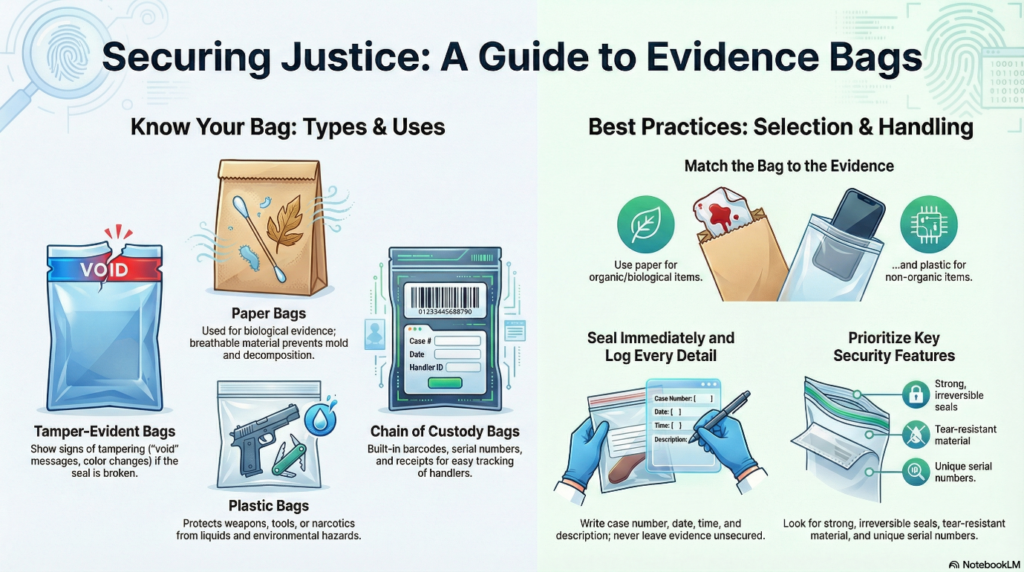
1. Tamper-Evident Bags
Tamper-evident bags are among the most widely used bags within law enforcement. These bags make tampering evident if anyone tries to open them. Once sealed, they show signs of tampering through color changes, a "void" message on the seal. These bags are perfect for currency, legal documents, sensitive devices, and other sensitive materials.
2. Paper Evidence Bags
Paper bags are commonly used to store biological evidence. They allow air circulation, helping prevent mold growth. Items like clothing, hair samples, and plant material are often kept in paper bags until they reach the lab.
3. Plastic Evidence Bags
Plastic evidence bags offer secure protection against liquids, debris, and other environmental hazards. They are commonly used for weapons, tools, electronics, narcotics, and other items that require a sealed environment.
4. Forensic Bags
Forensic bags have a very high durability and advanced sealing features. These bags are specifically designed for lab testing and long-term storage. They maintain the quality of the sample while preventing chemical interactions.
5. Chain of Custody Bags
The chain of custody bags have the built-in capability for tracking and tracing. They contain barcodes, tear-off receipts, and sequential numbering. This way, they make it much easier to document every transfer of evidence from one handler to another.
6. Cash Deposit Bags
Although used in banking, cash deposit bags follow similar standards to evidence bags. They include tamper-evident seals and tracking information. Many agencies use them for storing seized money during raids or investigations.
Each type supports secure packaging standards and helps preserve authenticity.
What to Look for in Quality Evidence Bags
If you are not sure how to select security bags or evidence bags, then consider these key points. They will help you make an informed decision.
- Tamper-Proof Seal
A good evidence bag should be difficult to tamper with. Look for bags with irreversible adhesive strips or locking devices.
• High Material Strength
These should be sufficiently strong to resist tears, punctures, and leaks. Plastic bags should be thick, while paper ones should be of good quality and resistant to moisture.
• Clear Writing Area
Make sure the bag has a large label space for case numbers, dates, officer names, and item descriptions.
• Unique Serial Numbers
Serial numbers prevent substitution and allow for tracking. Most evidence bags contain barcodes.
• Compatibilities with Storage Conditions
Some evidence must be refrigerated, while others have to be kept at room temperature. Select bags suitable for different conditions.
• Chemical Resistance
Special forensic bags prevent chemicals from leaking out of or reacting with the bag.
• Secure Packaging Design
This also includes one-way seals, durable film, tear-off receipts, and trackable features. These features enhance the reliability of the bag during the investigation process.
How Evidence Bags Protect the Chain of Custody
Chain of custody is amongst the most critical components in evidence management. It documents who handled the item, at what time, and for what reason.
Evidence bags help maintain the chain of custody by:
- Providing trackable labeling
- Offering tamper-evident protection
- Including Tracking Numbers
- Recording transfer details on bag logs
- Preventing contamination
Using the right bags helps ensure that the chain of custody is clear, reliable, and complies with the law. This is the reason chain of custody bags are still highly valuable in any kind of investigation.
How Law Enforcement Uses Evidence Bags
Everything must be taken care of, from fingerprints to firearms, when they are seized by police. Evidence bags are used to store:
- Weapons
- DNA samples
- Cash
- Drugs
- Thrift or second-hand clothing
- Electronics
- Documents
- Tools
Each category calls for a different type of secure packaging. Officers are trained in selecting the appropriate bags, how to seal them properly, and how to document those seals as well.
Best Practices When Using Evidence Bags
Knowing how to choose an evidence bag is only halfway done. Correct handling is just as important. Here are some of the key practices that keep evidence safe.
1. Seal Immediately
Immediately seal the bag after the item has been placed within it. Never leave evidence unsecured.
2. Log Every Detail
Write down the case number, date, time, location, and description.
3. Avoid Overfilling Bags
Bags need to be sufficiently spacious for tight closure without stretching or distortion.
4. Use the Right Bag for the Right Item
Biological samples require breathable bags, whereas liquids and electronics require waterproof options.
5. Avoid Contamination
Wear gloves and handle items carefully. Avoid placing bags on dirty surfaces.
6. Store Properly
Follow temperature, humidity, and security storage guidelines.
How to Choose the Right Evidence Bag: A Simple Guide
Step 1: Identify the Type of Evidence
Is it biological, electronic, monetary, or physical? Each requires different forms of secure packages.
Step 2: Verify Tamper-Proof Features
Opt for the tamper-evident bags that have irreversible seals if maximum security is needed.
Step 3: Choose the Right Material
Choose plastic for non-organic items, paper for organic material, and forensic bags for lab samples.
Step 4: Search for Tracking Features
Barcodes, receipts, and serial numbers ensure the chain of custody.
Step 5: Assure Durability
The bag should be resistant to tears, moisture, and pressure.
Step 6: Certification Verification
Choose those that meet the standard requirements set by the law enforcement guidelines.
Step 7: Compare sizes
Use a bag that fits the item with no extra space.
The Bottom Line:
More than being just a simple storage tool, evidence bags play an important role in keeping critical pieces of evidence secure. Be it security bags, tamper-evident bags, cash deposit bags, chain of custody bags, or special forensic bags, making the right choice ensures that items remain authentic and untouched.
At iSell Packaging, we offer high-quality evidence bags to law enforcement agencies and private investigation firms as well. Let us know how we can meet your requirements. Get a quote now!
